Thursday, November 27, 2014

On the boat to Iquitos


I'm sitting on the back our our hospital speed boat, heading to Iquitos, with the bright sun reflecting off of the calm water to my left. To my right, the sky is somewhat overcast and Treycy is sitting in her mom's lap, smiling with a cast on her arm. Grodier, an amazing young carpenter and father of three, is laying on a stretcher in the front of the boat. He can't walk and we suspect that he fractured his back after falling down carrying a door. Our new pharmacist Luis Alberto is at my side. Since his arrival, patients have not wanted for any medicines. He does a good job.


Charlie is home with dad, and for the first time I'm traveling without him. Knowing that we should return by tomorrow afternoon to Santa Clotilde makes this a gentle transition. I have no worries... I came home from my first "real" call two days ago (in other words I was in the hospital the whole evening, overnight, and then all morning rounding on our 25 patients and tending to patients who arrived with malaria, vomiting, and dehydration). Brian was in the shower. Charlie was fed, bathed, clothed, and watching Rio2. The laundry was done, the house was clean, veggies washed, powdered milk made, and he had food waiting for me. So as you could imagine, I'm loving this boat ride... it's the first 
time in over a year I've had to myself. 


What a miracle it is really, to be here in Peru.
Charlie is 16 months and I've been considering weaning him from nursing. The local wisdom that I consistently hear while talking to other mothers here is "put toothpaste on and then he wont want to nurse anymore." After weeks of contemplation, I tried it. It worked like magic! After one taste of toothpaste, he wanted nothing to do with me. I offered him a bottle which he happily accepted. Multiple times throughout the day he would re-address the issue, pulling my shirt down and digging for a drink. Every time, he saw the flaking toothpaste and the smell of mint, looked at me and cringed his nose, and walked away. After 15 hours, I actually gave up. He was half asleep at 10pm, fussing and crying, and I was tired and overfull, so I gave in. I thought maybe a bit of a slower transition over a couple weeks would work better for me.


Work has been busy and fulfilling. I feel so happy to be able to meet the needs of local
families. Last night we gave Treycy ketamine to reduce her fracture and cast her arm. We played lullabies and talked about rainbows and butterflies and she smiled. This morning I walked over, knocked on her cast, and asked her "when did you put this on?" and she giggled, shrugged her shoulders, and replied "I dont know." The beauty of ketamine is that kids don't hurt and remember nothing. We also have 3 kids in the hospital with glomerulonephritis and high blood pressure, three patients with HIV- two of whom are incredibly sick, a bunch of people with pneumonia and possibly TB, a few kids with severe malnutrition, fevers, and big livers. One 14 year old boy had surgery for spina bifida as a baby and although he can walk, he has ulcers on his butt and foot because he lost some of his sense of feeling and forgets to shift his weight. He's healing well. We had a woman who was 22 weeks pregnant with a severe infection in her belly who ended up delivering a very premature baby. Another woman was on her way to our hospital from 4 hours upriver and ended up delivering TWINS en route, in her canoe. The mom and full-term healthy twin girls arrived healthy and breastfeeding and went home two days later. 

In Iquitos, after bringing the patients to the hospital and ensuring they get the X-rays and care they need, I'll be shopping to re-stock our pantry and buy a few fresh items for thanksgiving dinner. Although Santa Clotilde is a small town, we find almost everything we need there. For the things we cant buy in Santa Clotilde, we go to Iquitos. For the things we cant find in Iquitos, like good ground coffee, hershey bars, and peanut M&Ms to fulfill Brian's addiction, we phone a friend and the monthly volunteers are often able to find room in their bag for us. We're so grateful for all the support from back home that allows us to serve here!

Sunday, November 9, 2014

Felicidades Vanessa, Bill y Baby Mia Valentina!


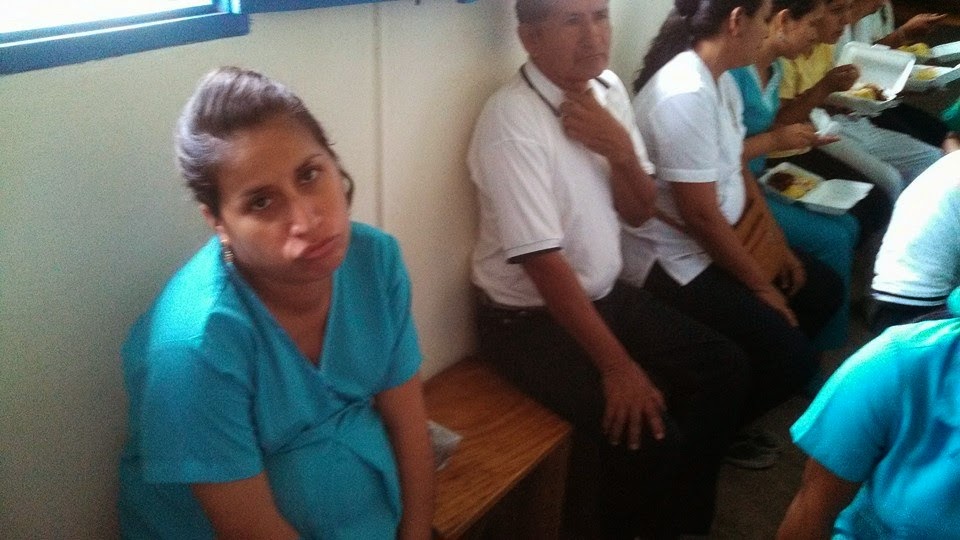
Vanessa is one of our superstar nurses. Having surpassed a couple of pre-term labor scares, and enjoying a fun filled baby shower last night at Lili's house (below), she arrived to Centro de Salud Santa Clotilde this morning in labor pain! As you can see above, she's ready for this baby to come!


                    Can mom or dad feed a baby faster?
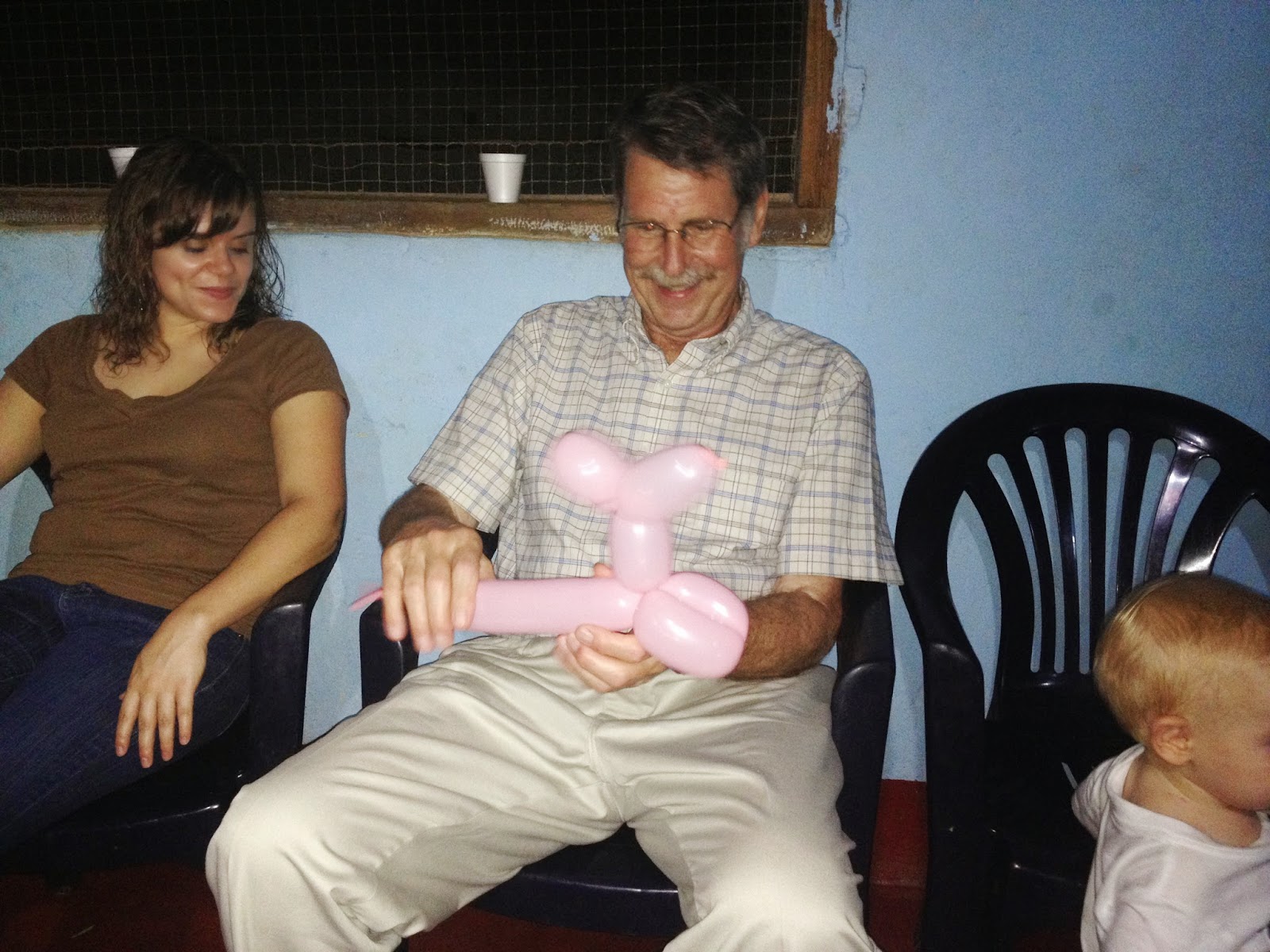
Padre Jack, making balloon animals!! What can't he do!


One last ultrasound for Vanessa! Baby looks good!

After saying an "Our Father", as is custom here, doctors Yesica and Toni perform a Cesarean Section, to find, as suspected....

A perfectly healthy, gordita baby girl Mia Valentina!! 

God Bless Vanessa and Bill and Baby Mia!


Friday, November 7, 2014

X-Ray


We've recently have two young mothers admitted with active tuberculosis. One lives here in town, and active TB was detected two days after she gave birth to her 5th child. Another woman from upriver came in to clinic with her 4 month old (her 4th child) and was diagnosed with active tuberculosis. All 9 children are PPD positive and need chest X-rays, as do the husbands and other family members. We need to know if these kids have active tuberculosis (which in children is sometimes asymptomatic), and the only way to know is based on chest X-rays. If we give them prophylaxis against tuberculosis and they have active tuberculosis, the bacteria will become resistant and transform the infection into a very hard to treat dilemma.

Do you know the diagnosis?


We do not have an X-ray machine here at Centro de Salud Santa Clotilde (CSSC). This is #1 on our needs list at the current time. We serve over 30,000 people along 250 miles of river. Our top three most common diagnosis here at CSSC are 1) infectious disease/parasites/abdominal pain, 2) respiratory infections like pneumonia, and 3) musculoskeletal complaints like fractures and trauma... most of which "require" an x-ray. It costs $100 per patient to go to Iquitos (on the fast public boat) for an Xray, most of which we end up covering because most of our population are subsistence farmers and don't have that amount of money.

Some families choose the "wait and see" approach to fractures in their children due to fear of the cost, and children end up with permanent disabilities. Without X-ray, we treat complex pneumonias including tuberculosis and attempt to put bone fractures back into place. We had a premature baby born with respiratory distress and after 10 days of no improvement she went to Iquitos and with a simple X-ray was diagnosed with a diaphragmatic hernia (intestines herniated into her lungs). Stranger things happen... we recently had a woman who swallowed a fish bone, but on evaluation we saw nothing in her throat. She admitted that it was no longer in her throat. On her second day here in the hospital, she was alert and talking, and we felt the fish bone starting to poke through the skin of her neck, and hours later she died. Maybe the X-ray would have detected the fish bone earlier and saved here life.

We have a long list of people who need X-rays, and we have rampant tuberculosis in the area, and we have a 35 bed hospital, and we have a fantastic radiologist at U of Michigan who reads all our X-rays (done in IQT)  for us, and we recently had a volunteer pulmonologist Dr. Wayne Farmer who gave two amazing talks on reading X-rays and tuberculosis, and we are living in the 21st Century. So why don't we have an X-ray machine? I ask myself this question almost daily. We are actually just $150,000 away from a portable digital X-ray machine, and have high hopes that the local government here will come thorough with funding next year, in collaboration with the local rotary club and maybe other generous donors. This will allow us to bring the X-ray machine to our 100 communities and formalize a tuberculosis program.


Cutaneous flour migrans

This is a bag of flour that we use to make pizza, pancakes, roux, tortillas, etc. 
"Cutaneous flour migrans"
 Most of the bugs come out with sifting, and we could use a little extra protein anyway!

Young couple, new parents

Congratulations to this young couple! Their beautiful baby boy was born quickly, with Brian present in case resuscitation was needed for the presence of meconium. Otherwise the midwife does the delivery with the nurse present for the resuscitation, and we're only called for complications. A great majority of patients here on the river deliver at home, but despite this, our midwives keep busy!


Thursday, October 30, 2014

Just a typical Monday


     Interesting how when one becomes accustomed to their daily routine how some unsual things seem to be ordinary and simple. 
     I will describe the day of work I was reflecting upon. It was a Monday morning a national holiday and a day off of work for all the staff that did not have a call in the hospital, myself included. I woke up to a cell phone call at 6am from our nurse who was in Iquitos for the long weekend. She was able to receive a message (as our fixed telephone lines were down) from an outpost about an 8 year old boy who was with a fever and very sick. So my day off turned into a beautiful day trip on the river. I called one of our boat drivers; a nurse technico in the hospital as well. By 730am we had our supplies, IV medicines and fluids, stethoscope, etc and off we went. After 4 hours on the river we found a gentleman sitting in a hollowed out tree trunk fashioned into a canoe. He directed us to the river branch where the patient, one of our technicos and the patient’s father were awaiting our arrival. Our technico from the nearest health post jumped into his boat and started an IV and antibiotics the night prior and was in contact with our nurse in Iquitos via a solar powered laptop and internet.  The child was waxing and waning in alertness but we arrived to Santa Clotilde that afternoon without problem.  He had pneumonia by exam and we adjusted some of his medications. On physical exam we noted swelling to his L wrist and thigh/knee. I was very concerned about the infection being in his bloodstream and entering his joints. The next morning he went on our boat with one of our nurses another 6 hours down to the regional hospital in Iquitos. He had x rays and was diagnosed with a severe pneumonia and septic joints. He stayed in the hospital several weeks, but recovered.
I give thanks for the dedicated workers we have on our river and the resources to be able to continue the work Padre Jack, Padre Moe and all the workers who elevated the level of care to be able to respond to needs of the over 300km of river we cover. God is Good.

Brian

Wednesday, October 8, 2014

Harold

Harold is 42 years old, the youngest of three brothers. Their parents are no longer living. Harold also has 4 children: six-year-old twins girls, a four year old and an 18 month old. His wife died just over a year ago of malaria, so he raises his children on his own, with the help of his two brothers and sister-in-laws.

Harold has had high blood pressure for years, with fluctuating creatinine´s. His creatinine (a test to see how the kidneys are functioning) had been slowly increasing. He was admitted to our hospital twice with his whole body swollen and his lungs and abdomen full of fluid. His kidneys were not able to get rid of the excess fluids. His last admission, he had a creatinine of 6 (usually once you reach 5 you need dialysis). Luckily the diuretics worked and he was able to urinate out some of the excess water and breath easier. We sent him to Iquitos where he was hospitalized at our referral hospital. He was sent back with a creatinine of 4, on the all the right meds to keep his water balance stable.

So yesterday and today, I spent a lot of time talking to Harold and his brothers about dialysis and renal transplant. Progression of kidney disease is often inevitable. Dialysis requires that he live in Iquitos, where he has no family members who could support him. He doesn't want to live hooked up to a machine two days a week, far from his community. His brothers just make enough to scrape by, selling the fish they catch and meat they hunt to support their own kids through school. They are not in a position to support him to live in Iquitos, nor in a position to donate a kidney, being that they must travel to Lima and spend many months away from their own families who are so dependent on them.

Despite the gravity of the whole situation, Harold has a constant smile on his face and the most positive attitude. The family has an immensely strong faith in God, and finds solace knowing that He is in control. We are all hoping and praying for a miracle- an improvement in his health and the return to normal of his kidney function. As you could imagine, he wants to be back in his community with his family. Once he gets there, he will continue the medicines that his kidney doctor has prescribed and also utilize plants and other natural remedies to attempt to cure his condition. Keep Harold and his children and family in your prayers!